

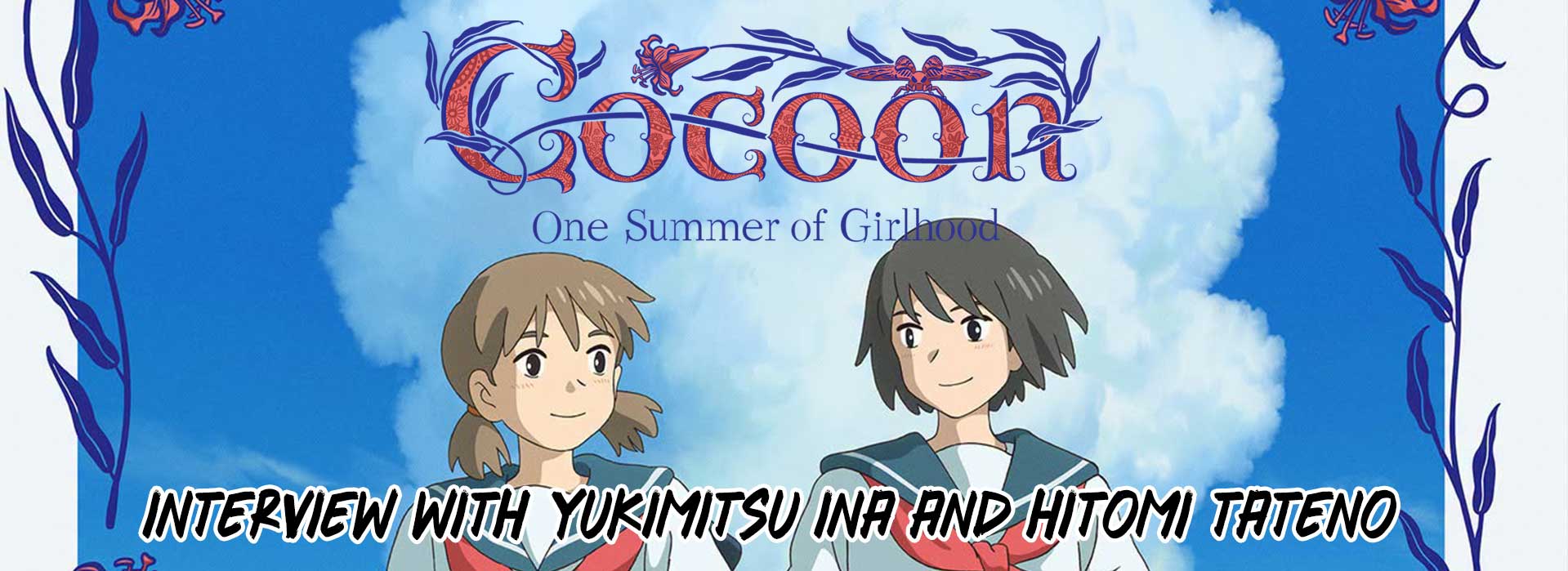
Director Yukimitsu Ina and former Studio Ghibli animator Hitomi Tateno speak with The Kitsune Network about portraying war through animation, building the film at SASAYURI, and encouraging younger viewers to think for themselves.
A warm island, an all-girls school, and two close friends named San and Mayu—the opening images of cocoon – One Summer of Girlhood carry a sense of tranquility. That peace is shattered when war reaches their shores and the students are ordered to care for wounded soldiers inside a military hospital hidden in a cave. As death and brutality close in around them, the girls struggle to hold on to one another and the fragile lives they once knew.
Based on the wartime manga by Machiko Kyo, cocoon – One Summer of Girlhood is the feature directorial debut of Yukimitsu Ina and the first feature from animation studio SASAYURI, founded by former Studio Ghibli animator Hitomi Tateno. The production unites veteran animators Akihiko Yamashita and Shinji Otsuka with a younger generation of artists, while composer kensuke ushio provides the film’s stirring score.

GKIDS is releasing the film in North American theaters beginning September 4, 2026, with screenings offered in the original Japanese with English subtitles and in an English-language dub.
Ahead of its theatrical release, Vtuber Krystal Vee spoke with Ina and Tateno about the responsibility of adapting such painful subject matter, the creative decision to replace blood with flowers, and the danger of allowing a crowd to determine what an individual believes.
The interview was conducted with Japanese-English interpretation. Responses have been translated primarily from the original Japanese and edited for clarity and conversational flow. This feature avoids major story spoilers.
Finding a First Film in cocoon
Although cocoon became Ina’s feature directorial debut, stepping into the director’s chair had not been a specific career goal. The project also brought several other firsts: it was his first time creating storyboards and, despite working collaboratively, his first experience helping shape a screenplay in that capacity.
“Honestly, part of it was simply that the timing worked out,” Ina told The Kitsune Network. “More importantly, when I picked up the original manga, I felt it could become an animated film.”

Rather than approaching the material with every answer already in place, Ina found the film by working through its images. As he developed the image boards, his confidence in animation as the right medium continued to grow.
“I was feeling my way through many things I had never done before, but I believed this story could become a film,” Ina explained. “As I continued drawing the image boards, I became convinced that animation could turn it into something people of my generation—as well as younger viewers, including teenagers—could watch and connect with.”
That desire to reach younger viewers became central to the production. cocoon does not soften the devastation of war, but its creators searched for a visual language that would allow audiences to confront that devastation without turning away.

When Flowers Become More Frightening Than Blood
For animation fans—and game players who pay close attention to how art direction can communicate what dialogue cannot—one of cocoon’s most striking choices is its use of flowers and petals during moments of bloodshed.
Tateno said the idea grew partly from her own difficulty with frightening imagery and the war stories she repeatedly encountered as a child.
“I have always been very uncomfortable with blood and frightening imagery,” Tateno said. “To be honest, I was not particularly eager to become involved with stories about war.”

She recalled that every summer brought new manga, books, television programs, and films about wartime suffering. Her generation was taught that terrible acts had occurred and that war must never be allowed to happen again. Tateno understood the importance of that lesson, but repeatedly watching graphic depictions of suffering was deeply painful for her.
“Even as a child, I wished they could be presented in a way that more people could bear to watch,” she said. “The pain was already understandable, so I wondered whether it could be expressed differently.”
Flowers offered that different form of expression—but they did not necessarily make the imagery less disturbing. Tateno recognized that beauty can contain its own sense of fear and that flowers can possess an appearance that is almost grotesque. Their delicate shapes and colors could therefore stand beside the image of blood more naturally than audiences might expect.
“When we decided that the blood in that scene needed to be replaced by something else, the idea of using flowers felt almost inevitable,” Tateno explained. “I wanted something beautiful, gentle, and tender while still making it clear that something terrible was happening. Flowers were the best way to express that.”
She then offered a more spiritual explanation for where the image came from: “Perhaps it was providence. Maybe God was telling me, ‘Use flowers.’”
The result is not an escape from violence. Instead, the flowers create a visual contradiction: something associated with youth, beauty, and life becomes inseparable from the horror surrounding the girls. It is a choice that invites viewers to feel the violence rather than merely observe it.

Building a Studio Around People, Not Walls
Tateno initially questioned whether SASAYURI should accept a project carrying so much historical and emotional responsibility. She believed the source material deserved a complete commitment and wondered whether a larger animation company would be better equipped to provide it.
“My company essentially consisted of a café and an animation school,” Tateno said. “It was almost like running a piano school, with me in the role of the teacher. I wondered whether an organization like ours could really make this film.”
Her years at Studio Ghibli, however, had taught her that animation is built by people rather than the size of a company’s building. If SASAYURI could assemble the right core artists, funding, and production resources, creating the film was possible.
“Through my experience at Studio Ghibli, I had learned how a film could be made,” she explained. “You gather the staff—especially the essential core staff—and you do not necessarily need a large studio building. If you can bring together talented people, funding, and the necessary resources, then it is possible to create a film.”
Tateno also saw an opportunity for SASAYURI to make the kind of wartime film she had wished for as a child. Stories about war can demand so much emotional energy that audiences never want to experience them again. Her ambition was to create something viewers might revisit—not because its subject was painless, but because they would want to return to San, Mayu, and the other girls.
“I thought that perhaps the staff I assembled and I could create a war film that audiences would want to revisit,” Tateno said. “There may have been a little ambition behind that belief. Perhaps it was a moment of madness. Some people might even call it irresponsible, but honestly, that was part of what I felt.”
War’s Second Terror: “A Death of the Spirit”
For Ina, understanding war requires confronting two different kinds of fear. The first is physical: gunfire, starvation, violence, and the destruction preserved in photographs and historical records. He believes those real images can communicate physical terror more powerfully than animation.

The second fear is internal.
“The second kind of fear is what I define as a ‘death of the spirit’—the way a person’s mind or spirit can be violated,” Ina said. “I felt that this was something I could address through animation.”
That psychological danger appears when people become controlled by a shared way of thinking. A group can move in the wrong direction while each person assumes it must be right simply because everyone else is moving with them. The challenge is recognizing what is happening—and finding the strength to break away.
“That idea is not limited to the past,” Ina said. “It can also be applied to the present and the future. If viewers can take that idea from the film and connect it to their own lives, I would be very happy. It would not be an exaggeration to say that this is at the heart of everything I wanted the film to express.”
That warning gives cocoon relevance beyond its historical setting. Whether someone encounters pressure in a classroom, an online community, a fandom, or the wider world, the film asks what can happen when belonging becomes more important than questioning where the group is headed.
The Courage to Think for Yourself
Tateno does not want to dictate a single correct interpretation of the film. In her view, audiences should be free to experience a story and reach their own conclusions. Still, she hopes younger viewers leave cocoon with the courage to resist being carried along by the crowd.
“Even if everyone tells you that you are wrong, I hope you can still say, ‘This is what I believe,’” Tateno said. “It is all right to be different. People can even hold completely opposite views.”

That independence must also be paired with compassion. Holding on to an individual belief does not require dismissing or harming someone who thinks differently.
“Each person should value and remain true to their own way of thinking,” she continued. “If possible, I hope everyone chooses a direction that does not hurt other people or allow something terrible to happen. That is what I hope viewers carry with them.”
For anime fans, cocoon – One Summer of Girlhood is a reminder of what animation can accomplish when visual beauty is used not to hide painful history, but to make its emotional reality impossible to ignore. Its flowers do not erase the blood beneath them. They give that suffering a shape that may remain with viewers long after the screen fades to black.
cocoon – One Summer of Girlhood is now playing in North American theaters in Japanese with English subtitles and in an English-language dub. Theater and ticket information is available through the official GKIDS film page.


Editor’s note: This interview was conducted with Japanese-English interpretation by interpreter, Satsuki and has been edited for clarity and conversational flow. The guests’ responses were rendered primarily from the original Japanese transcript, with the English transcript used to confirm context and speaker order. Video version of the interview can be found here.
Stay tuned to The Kitsune Network for more anime coverage, interviews, and convention features.