

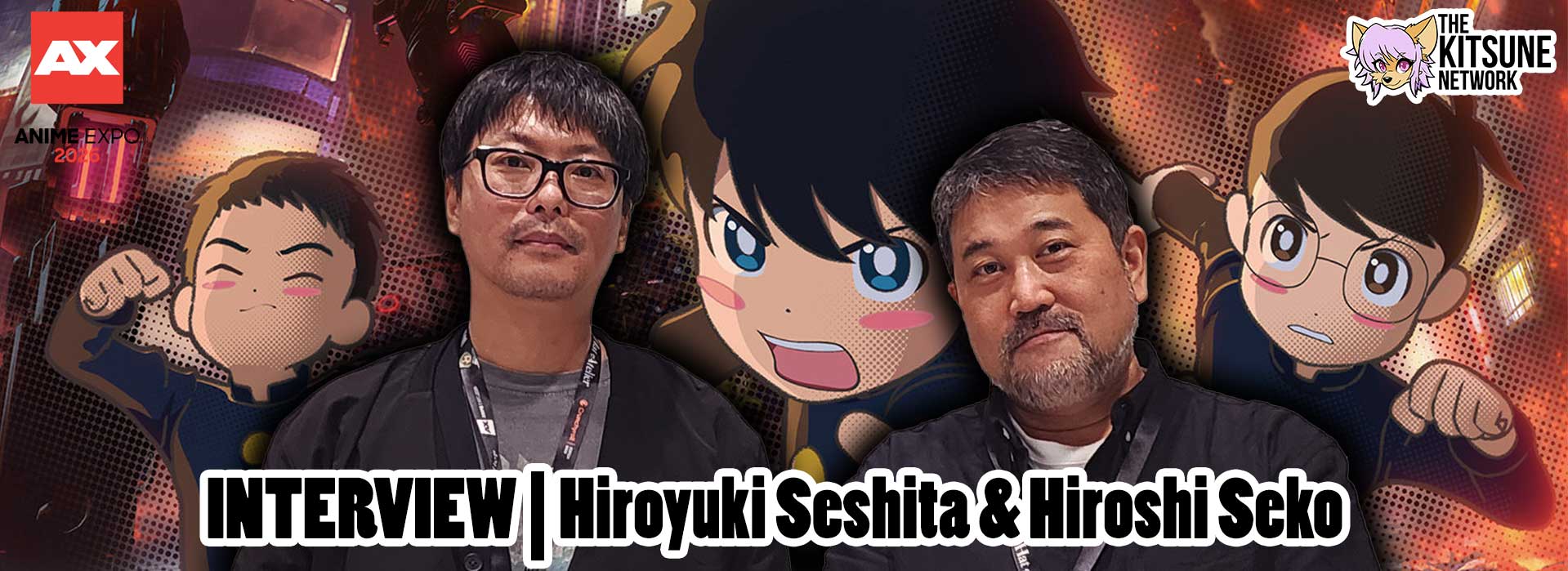
The director and scriptwriter discuss key visuals, character-first adaptation choices, and why hearing fans shout “No!” was exactly the reaction they wanted.
Thunder3 looks like two different anime – or two different game engines – collided inside the same frame. For the creative team, that reality-bending contrast is not a gimmick. It is the key to bringing Yuki Ikeda’s singular science-fiction manga to life.
The Small Three are not exactly the heroes most worlds would choose. Pyontaro Tezuka, Hiroshi Ochanomizu, and Tsubame Azuma are ordinary middle schoolers who play a mysterious disc borrowed from their teacher, Doc. When Pyontaro’s younger sister, Futaba, disappears into the other universe shown on the screen, the trio follows – and discovers that the visual rules, power levels, and dangers of that world are very different from their own.
During Anime Expo 2026, The Kitsune Network spoke with Thunder3 chief director Hiroyuki Seshita and series composition and scriptwriter Hiroshi Seko about the unusual challenge of adapting those clashing realities. Their answers revealed a production driven as much by affection for the characters as by high-concept visual experimentation.

A Manga That Had to Move
Asked why Thunder3 needed to become an anime, Seshita did not overcomplicate the answer: “It is very simple: I read the original manga and found it incredibly interesting.”
Seko responded with the kind of dry joke that immediately established the pair’s easy rapport. “Because Mr. Seshita told me, ‘Do it,'” he said before laughing and clarifying that Seshita had simply invited him to join the project.
Beneath the joke is a serious adaptation problem. Thunder3 is not merely a manga with two settings; it is built around two dramatically different visual languages. The Small Three and their familiar world carry an overtly manga-like charm, while the universe beyond the screen is rendered with a much harsher sense of reality. Animation had to preserve that collision without making either side feel like it belonged to a completely different production.
No Spoilers, No Homework
For newcomers wondering how much they should learn before pressing play, Seshita and Seko offered the same advice: nothing at all.
“They do not need to know anything,” Seshita said. “I would like them to simply enjoy it without any prior knowledge.” Seko agreed, adding that he would actually prefer viewers not seek out advance information before starting the series.
That is a refreshing instruction in an era when seasonal anime arrives surrounded by trailers, character videos, manga comparisons, and frame-by-frame fan theories. Thunder3 wants the first encounter to feel like finding a strange disc yourself: familiar for a moment, then suddenly impossible to predict.
When the Characters Outgrow the Storyboards
The most exciting surprise for Seshita was not a giant action sequence or a technical breakthrough. It was watching the characters become even more charming once they moved and gained color.
He explained that the cast’s appeal grew far beyond what the team expected, to the point that they added shots that had not been part of the original plan. The potential had always existed in Ikeda’s manga, but animation made the production team see the characters differently.
Futaba and her dog Pusuke stood out to both Seshita and Seko. Seshita was surprised by how lovable the pair became on screen, while Seko said their simple presence could sustain a moment even when the plot was not advancing. For anyone who has ever watched a game companion steal an entire scene through a tiny idle animation, the feeling should be instantly recognizable. “Their presence alone can carry a scene, and that helped us enormously.” said, Seko.
Designing the Collision Between Two Worlds
Finding the right visual boundary between the manga world and the realistic universe became one of Seshita’s greatest challenges. Early experiments pushed the contrast in obvious directions. The team considered presenting the realistic world in black and white. They also tested an extremely detailed, realistic approach.
Neither solution worked. Making the world too realistic stripped away its appeal as animation. Turning it black and white created separation, but it weakened the drama taking place there. The goal was more delicate: the realistic world needed to remain visually engaging while the arrival of the manga-like characters still felt strange and disruptive.
The answer came from the original manga covers. Seshita’s team surrounded the manga-world characters with halftone dots inspired by older American comics and the limitations of early printing technology. The effect lets the characters carry a trace of their home medium into the other universe, creating a boundary without breaking the image apart.
“That became the visual rule that defined the style,” Seshita said. It is the kind of elegant visual solution that anime and video game fans love to dissect: a simple effect that communicates world-building before a character says a word.

Giving Segami Room to Breathe
Adaptation also meant knowing when the anime needed more material. Seko pointed to Teichi Segami, the constantly complaining college student whose internal monologue became one of Seshita’s favorite elements in the realistic world.
The manga material surrounding Segami was not long enough to fill an entire episode exactly as written, so Seko expanded his scenes and dug deeper into his personality. That decision is especially visible in the anime’s fourth episode, “MR. SEGAMI.”
Seko was careful to distinguish the expansion from filler. “It was not background material or simple filler; we used the additional time to give his character more depth,” he explained. The added material gave the anime room to communicate Segami’s charm and oddness instead of treating him as a bridge between larger plot points.
Protecting the Manga Without Freezing It in Place
For Seko, the central responsibility of adaptation is preserving the appeal of the original work without treating manga panels as untouchable storyboards. Manga, he noted, is constructed from connected still images on paper. Anime has to transform those images into movement in the most interesting way possible.
That transformation requires choices about pacing, episode length, comedy, action, and where a scene needs more breathing room. Yet one rule remains constant. “The greater challenge – and this is true of any adaptation, not only Thunder3 – is never losing the appeal of the original work,” Seko said. “That is the foundation of everything.”
It is a philosophy visible throughout the interview: fidelity is not measured by recreating every panel at the same speed. It is measured by whether the anime can reproduce the feeling that made the manga worth adapting in the first place.
The Best Kind of “No!”
The director and scriptwriter had just returned from an Anime Expo screening when Krystal asked about their favorite audience reaction. Seshita said viewers responded emotionally to the same moments that moved the production team, creating the sense that their intentions had reached the room exactly as planned.
Then episode two ended – and the audience loudly objected.
“It was a very audible ‘no,'” for Seshita and Seko, that was a victory. The cliffhanger had landed. Seko was equally pleased that the crowd laughed at the moments designed for comedy before shouting when the episode stopped. “Hearing everyone shout ‘No!’ made me incredibly happy,” he said.
That reaction may be the clearest sign that Thunder3’s complicated mixture is working. The show can jump between meta-comedy, hard science fiction, alien danger, and character-driven absurdity, then still make a room full of fans demand the next episode in unison.
The Cliffhangers Are Just Getting Started
Seshita hopes manga readers will appreciate how movement makes the cast feel more alive and emotionally accessible, allowing viewers to travel through the story alongside them. For everyone else, his advice remains simple: avoid overthinking it and start watching.
He also had a warning for the fans who shouted at the end of the Anime Expo screening: “Be prepared, because the cliffhangers are going to keep coming.”
Seko made the final pitch even more direct. Watch the first episode, he said, and you will want to continue. Considering the reaction at Anime Expo, plenty of viewers have already discovered that stopping may be the hardest part.
Where to Watch and Read Thunder3
Thunder3 began airing July 8, 2026, on Fuji TV’s +Ultra programming block in Japan and is available on Netflix. Kodansha publishes Yuki Ikeda’s original manga in English in print and digital formats.
This article is based on The Kitsune Network’s interview with director Hiroyuki Seshita and scriptwriter Hiroshi Seko at Anime Expo 2026. Interview responses have been lightly edited for clarity.
Watch our full interviews above, and stay tuned to The Kitsune Network for more anime coverage, cast interviews, and convention features.