

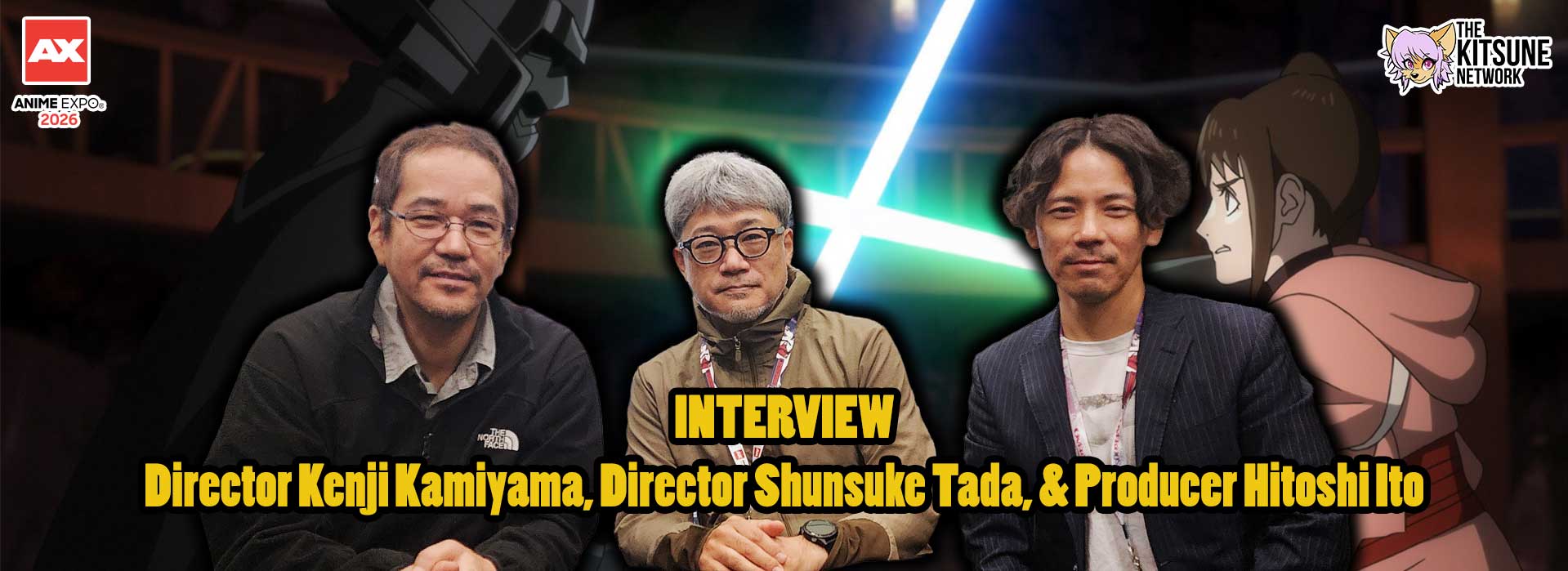
Supervising Director Kenji Kamiyama, Director Shunsuke Tada, and Producer Hitoshi Ito discuss Lah Kara’s next chapter, the mystery surrounding Lah Zhima, color-changing lightsabers, and building the series with Lucasfilm.
A lightsaber that changes color according to the heart of its wielder. A former Jedi living quietly as a lightsaber smith. A young heroine stepping toward a new era while the history of the Jedi has nearly faded away.
The Ninth Jedi introduced enough ideas to fill an entire corner of the Star Wars galaxy, even though its original story was told as a short within Star Wars: Visions. Its world felt larger than the time available to explore it, leaving viewers with questions about Lah Kara, her father Lah Zhima, and the unusual lightsabers at the center of their journey.
That sense of a much bigger story was not accidental.
In an interview with The Kitsune Network, Supervising Director Kenji Kamiyama, Director Shunsuke Tada, and Producer Hitoshi Ito discussed how The Ninth Jedi is growing from a self-contained short into a full series. Their answers reveal a project built around unfinished character stories, ambitious animation challenges, and a closer creative partnership with Lucasfilm.

A Larger Story Was Already Waiting
Kamiyama did not begin expanding The Ninth Jedi from an empty page. Long before the series became possible, he had already developed far more of its characters and world than viewers could see in the original short.
“Whenever I create a work—not only this one—I develop far more background material than what ultimately appears on screen, including the story, characters, and world,” Kamiyama explained. “Even though The Ninth Jedi was a short, I dug deeply into each character and created detailed settings for them.”
Fans noticed that extra depth. Kamiyama recalled viewers discussing the short on social media and sensing that a larger story existed behind what they had watched. Because he already had ideas for where that story could go, he hoped there would eventually be an opportunity to revisit it.
That opportunity arrived when Lucasfilm approached the team about expanding the project.
“I felt it was an opportunity we had to take,” Kamiyama said.
The result is not simply more time in the same setting. The series gives the team room to return to mysteries that were essential to the original short but never fully explained.
Lah Zhima Is Where the Story Begins

For Kamiyama, the most important thread to preserve was Lah Zhima, Kara’s father.
The original short established that Lah Zhima was a former Jedi who had become a lightsaber smith before being abducted. However, it left the reasons behind those events largely unexplored. Why had he abandoned his former life? Why was he targeted? What happened before Kara’s journey began?
Those questions are not side material. According to Kamiyama, they form the foundation of the larger story.
“Those unanswered questions are central to the short, and they are also where the entire story begins,” he said.
When developing the series, Kamiyama wanted to place Lah Zhima at the center and rebuild the story around his past as one of its main pillars. That approach gives the expansion a strong emotional core: Kara’s future is connected to a history involving her father, the lost Jedi, and the lightsabers he learned to forge.
Instead of simply sending Kara toward the next adventure, the series can explore the events that placed her on that path in the first place.
Building Kara’s New Jedi Group

While Kamiyama focused on the history driving the plot, Tada concentrated on the relationships carrying it forward.
Tada joined The Ninth Jedi for its continuation and was not involved in producing the original short. When examining where the story had ended, he saw room to better define the relationships among Lah Kara, Ethan, Homen, and their master, Juro.
The characters had gathered, but their individual positions within the group were not yet completely clear. Tada wanted the series to reveal who they are through more than exposition.
“We worked to reveal that through their dialogue, behavior, and small gestures,” Tada said. “Giving those relationships more depth was very important to me.”
For anime fans, those smaller interactions can be just as important as the next major battle. A glance, an argument, or the way one character reacts under pressure can define a group long before anyone explains their feelings aloud. By giving the cast more room to interact, the series can turn the promising party assembled in the short into a more convincing team.
Ito identified another element that needed to remain at the center: Kara’s path toward becoming a new kind of Jedi. Her development and the lightsabers created by Kamiyama are closely connected, allowing the series to explore a new era through both character growth and visual storytelling.
The Lightsabers Created an Animation Challenge


The color-changing lightsabers were among The Ninth Jedi’s most memorable ideas. Rather than remaining fixed, each blade reveals something about the heart of the person holding it.
Preserving that concept in a full series was not guaranteed.
Kamiyama explained that the freedom of Visions made it possible to take risks with the familiar rules surrounding Jedi and lightsabers. Expanding those ideas into a much larger production raised concerns about whether the concept differed too greatly from the established Star Wars setting—and whether fans would continue to accept it.
Support from Ito and Lucasfilm helped the team preserve what made the short distinctive. Because the story exists outside the canon and takes place in the distant future, the team could imagine a world in which the familiar Jedi and their lightsabers had disappeared.
Fan enthusiasm for the original short also mattered. Viewers had already embraced the surprise of seeing lightsaber colors work differently, giving the team confidence to take that creative risk again on a larger scale.
For Tada, however, preserving the idea created a practical animation problem: How do you make those colors visibly different without losing the intense glow that makes a lightsaber feel like a lightsaber?
A dramatic shift from Jedi blue to Sith red is relatively easy to communicate. The colors belonging to Ethan, Homen, and Kara are much more subtle. Viewers can recognize the differences when the blades are compared directly, but reproducing those slight variations consistently on screen required careful work.
The brighter a lightsaber shines, the more its highlight moves toward white, which can wash away the hue the animation team needs the audience to see. The silver lightsaber was the hardest of all.
“Silver is not simply a color; in many ways, it has to be expressed through texture,” Tada explained. “We conducted many tests to make sure it looked right.”
It is the kind of technical detail viewers may register without consciously noticing. If the effect works, the lightsabers remain bright, powerful, and instantly readable while still communicating something unique about each wielder.
Creating Star Wars Across Two Storytelling Traditions


The move from short to series also changed the team’s relationship with Lucasfilm.
Ito explained that the original Visions short was made with considerable creative freedom. Lucasfilm largely trusted the team to develop its own interpretation unless a major issue arose. A full series, however, was a bigger project, and Lucasfilm naturally became more closely involved.
That involvement led to frequent feedback, detailed discussions, and a more collaborative production process. It also required both teams to navigate differences between Japanese and Western approaches to storytelling.
Ito noted that Japanese stories sometimes trust the audience to understand an idea without stating it directly. Western storytelling may ask for the same moment to be explained more explicitly or structured more logically. Reconciling those approaches required patience and careful communication from the production team.
The process was demanding, but Ito described it as equally rewarding.
“Working together as a genuine co-production between the Japanese and American teams taught me a great deal,” Ito said, adding that the project was built on strong mutual respect and trust between the anime staff and Lucasfilm.
That collaboration could become one of the series’ greatest strengths. The Ninth Jedi began as a Japanese animated interpretation of Star Wars, but its expansion is being shaped through a deeper exchange between the teams responsible for both sides of that identity.
Forging the Next Chapter

At its core, the expanded version of The Ninth Jedi is holding onto the ideas that made the original short so compelling: a distant future where the Jedi have nearly disappeared, lightsabers capable of revealing their wielders’ hearts, and Lah Kara’s journey toward becoming something new.
The difference is that the team can now explore the history and relationships behind those ideas. Kamiyama is returning to the larger world he had already imagined. Tada is giving Kara, Ethan, Homen, and Juro room to become a believable group. Ito is helping bridge two storytelling traditions as the production grows alongside Lucasfilm.
For fans who finished the short convinced that an entire galaxy existed beyond its final scene, Kamiyama’s answer confirms that instinct was right. The Ninth Jedi always carried the foundation of a much larger adventure. Now, its supervising director, director, and producer are finally forging the rest of that story.
About The Ninth Jedi
In the new series, Lah Kara continues to train in the ways of the Jedi under Margrave Juro. Kara goes on an epic journey of self-discovery as she and Juro’s small fellowship of Jedi in training embark on a quest to save her father and stop a mysterious Sith leader from unleashing darkness upon the galaxy.
Part of an all-new banner, “Star Wars: Visions Presents,” which will be used to tell longer-form “Star Wars: Visions” stories, the limited series picks up not long after the events of the Visions shorts “The Ninth Jedi” and “The Ninth Jedi: Child of Hope.”
Interview responses were lightly edited for clarity. The Japanese-language responses were prioritized when reconstructing the original conversation.
Watch our full interviews above, and stay tuned to The Kitsune Network for more anime coverage, cast interviews, and convention features.